What Is Tide Coefficient?
The Number on Your Tide Chart That's Telling You More Than You Think
Tide coefficient is piece of tidal data that isn't always reported on US tide tables. More popular on European fishing sites — it is a number next to the tide, usually somewhere between 20 and 120, labeled "coefficient." Some days it's 45. Other days it's 95. Nobody ever explains what it means, but fishermen are starting to pay more attention to this data when planning their trips.
If you fish in the U.S., you've probably never heard of tide coefficient at all. American tide charts don't show it all that often - you're more likely to see it referenced in marine forecasts from European sources. But the data behind it — the tidal range — is sitting right there in every tide chart you've ever looked at. You just might not have known what to do with it.
Let's fix that.
Tide Coefficient: The Short Version
Tide coefficient is a number that represents how strong or weak the tides will be on a given day. Higher coefficient means a bigger difference between high and low tide, which means more water movement, stronger current, and — in most situations — better fishing.
The concept comes from French maritime tradition, where it's been used for decades by fishermen, sailors, and coastal engineers. The scale runs from about 20 (the weakest possible tide) to 120 (the strongest). An average tide sits around 70. Anything above 90 is considered a strong tide; below 45 is weak.
Here's the thing — tide coefficient is really just a fancy way of expressing tidal range. And tidal range is something you can see on any tide chart, anywhere. You don't need a European fishing site to use this information.
What Is Tidal Range (And Why It Matters More Than Tide Height)
Most anglers check their tide chart and look at one thing: what time is high tide, what time is low tide. Maybe they glance at the heights. But very few people look at the difference between the high and low — and that difference is where the real fishing information lives.
Tidal range is simply the height difference between a high tide and the adjacent low tide. If today's high is 4.8 feet and the following low is 0.2 feet, the tidal range is 4.6 feet. If tomorrow's high is 3.2 feet and the low is 1.5 feet, the range is only 1.7 feet.
That difference — 4.6 feet versus 1.7 feet — tells you everything about how much water is going to move through your fishing spot today.
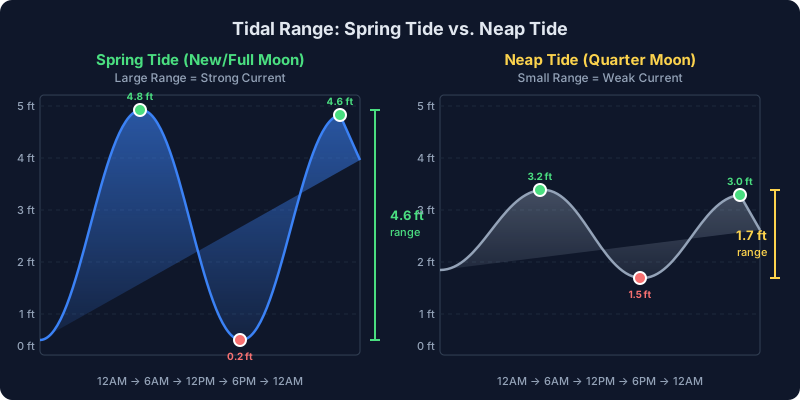
Big range means a lot of water has to move between high and low tide in roughly the same amount of time. That creates stronger current. Stronger current pushes more bait, flushes more nutrients, and triggers more aggressive feeding from predators that stack up in ambush points.
Small range means less water movement, weaker current, and generally less urgent feeding behavior. Fish are still there — they're just not getting the same buffet delivered to their doorstep.
The Simple Rule: Bigger tidal range = more water movement = more feeding activity. This is why spring tides (new and full moons) produce the best fishing for so many anglers — the range is at its peak, and everything in the water column responds to it.
How Tide Coefficient Is Calculated
If you're curious about the actual math (and you don't have to be — skip to the next section if you just want the fishing application), here's how tide coefficient works.
The formula normalizes a day's tidal range against the largest possible tidal range at that location — known as the mean spring equinox range. In the European system:
- Coefficient 120 = the absolute maximum tidal range possible at that station (equinox spring tide at lunar perigee — when the moon is closest to Earth)
- Coefficient 70 = average tidal range
- Coefficient 20 = the weakest possible tide
So a coefficient of 95 means today's tidal range is about 95/120ths of the maximum range that location ever sees. That's a big tide day.
The key insight is that coefficient is location-specific. A coefficient of 95 at a station in Tampa might represent a 3.5-foot range. That same coefficient at a station in Charleston could mean a 6-foot swing, and in Maine it might represent a 14-foot range. The absolute numbers are different, but the relative strength — "this is a big tide for this location" — is the same. That's what makes coefficient useful regardless of where you fish.
Tidal Range vs. Tide Coefficient: What's the Difference?
For practical fishing purposes, not much. They're measuring the same thing — how strong the tides are — just expressed differently.
| Tidal Range | Tide Coefficient | |
|---|---|---|
| What it measures | Height difference between high and low (in feet or meters) | Relative strength of the tide (dimensionless number) |
| Scale | Varies by location (1 ft in the Gulf, 10+ ft in New England) | Universal 20-120 scale |
| Where you'll see it | U.S. tide charts, NOAA data | European fishing sites, French tide tables |
| Best for | Understanding your specific spot | Comparing days at the same location |
The advantage of tidal range is that it's concrete — you know exactly how much water is moving. The advantage of coefficient is that it normalizes across locations, so "95" means "big tide" whether you're in Brest, France or Ballast Point, Florida.
For U.S. anglers, tidal range is more practical because it's what your tide chart already shows. You don't need to convert anything or look up European tables. Just subtract the low from the high and you've got the number that matters.
What Different Tidal Ranges Mean for Your Fishing
Here's the practical guide. These ranges are general — your local waters will have their own patterns, but the principles hold everywhere.
Large Range (Strong Tides)
When: New and full moons (spring tides), especially during equinoxes or when the moon is at perigee.
What's happening: Maximum water movement. Strong current through channels, inlets, and over structure. Water levels change rapidly — flats that are wadeable at low tide can have three feet of water two hours later.
Fishing strategy:
- Fish current edges, ambush points, and structure where moving water concentrates bait
- Topwater and moving baits work well — fish are actively hunting
- Time the tide changes carefully. The two hours before and after each change produce the strongest current and usually the best bite
- Watch your access. Strong tides can drain flats fast or flood areas that are normally walkable. Don't get stranded
Species that love it: Anything that ambush-feeds in current — snook, tarpon, striped bass, redfish at inlet mouths, bluefish, jacks. These fish know how to use strong current to their advantage and they're actively positioned to eat.
Moderate Range (Average Tides)
When: Between spring and neap tides. The transition days as the moon moves from new/full toward quarter phases (or back).
What's happening: Decent water movement without the full-throttle current of spring tides. This is "normal" for most locations and represents the bulk of your fishing days throughout the month.
Fishing strategy:
- Standard approaches work well. Match your technique to the structure and species
- Current is present but manageable — good for working both moving baits and slower presentations
- Less extreme water level changes give you more consistent access to your spots
- These are reliable, predictable fishing days where tide timing and spot selection matter most
Small Range (Weak Tides)
When: Quarter moons (neap tides). First and last quarter phases produce the smallest ranges of the month.
What's happening: Minimal water movement. Current is weak or barely noticeable. Water levels don't change much between high and low. Channels that normally rip with current might feel almost slack.
Fishing strategy:
- Slow down everything. Less current means fish aren't getting food delivered, so they're either lazier or actively searching — not posted up in ambush spots
- Sight fishing can be excellent. Less water movement usually means better visibility on the flats
- Downsize your presentations. Fish have more time to inspect your bait
- Wind-driven current becomes more important. On neap tide days, a steady 10-15 mph wind can actually create more water movement than the tide itself
- Fish structure more thoroughly. Without current sweeping bait past them, fish hold tighter to cover
Don't Skip Neap Tides: Some of my best sight-fishing days in Tampa Bay have been during neap tides on calm mornings. The water is skinny, clear, and the fish are right there on the flat — you just have to find them and make a good presentation. Different game than ripping current at the inlet, but just as fun and sometimes more productive than you'd expect.
How We Show This on My Marine Forecast
Instead of making you do subtraction in your head every time you check the tides, My Marine Forecast calculates the tidal range for you and displays it right alongside the high and low tide predictions on your daily tide chart.
You'll see three things in the tide header:
- Low tide — time and height
- High tide — time and height
- Tidal range — the calculated difference in feet, plus a strength label
The strength labels work like this:
| Tidal Range | Label | What It Means |
|---|---|---|
| 4+ feet | Strong (green) | Big water movement. Prime current-feeding conditions. |
| 2-4 feet | Moderate (yellow) | Average movement. Solid, reliable fishing conditions. |
| Under 2 feet | Weak (gray) | Minimal movement. Adjust tactics — sight fish, slow down, fish structure. |
This gives you the same information as a tide coefficient without needing to look up European tide tables or understand the normalization math. You see the actual range in feet for your specific station, and the label tells you at a glance whether it's a big-current day or a slow-current day.
Quick Comparison: If you've used sites that show tide coefficient, here's roughly how the labels translate: Strong (green) is roughly coefficient 85+, Moderate (yellow) is roughly 50-85, and Weak (gray) is below 50. The exact mapping varies by location since the labels are based on absolute range, but the general idea is the same.
Using Tidal Range with Other Factors
Tidal range doesn't exist in isolation. Like everything else in fishing, it's most useful when you stack it with other conditions.
Range + Feeding Periods
A major solunar feeding period that falls during a strong-range tide change is about as good as the calendar gets. You've got the gravitational feeding trigger from the moon transit, the current-driven bait movement from the tide, and maximum water velocity from the large range. If all three overlap and you're not on the water, you're missing it.
Range + Barometric Pressure
Large tidal range during falling barometric pressure before a front is the scenario that produces those legendary days everyone talks about at the dock for months afterward. Strong current plus a pressure-driven feeding trigger. If you see this lineup in the forecast, go fishing. Call in sick if you have to.
Range + Wind
On weak-range neap tide days, wind becomes your friend instead of your enemy. A steady 10-15 mph wind can push water across flats and through channels in ways that supplement the anemic tidal current. This is especially true in Galveston and other Gulf areas where wind-driven tides can rival the astronomical tidal range. Pay attention to wind direction on low-range days — the downwind shoreline is where bait gets pushed, and predators figure that out fast.
Range + Time of Year
Tidal ranges are naturally larger around the equinoxes (March and September) and smaller around the solstices (June and December). If you're planning trips months in advance, the equinox spring tides — when the sun's equatorial alignment amplifies the moon's gravitational effect — produce the biggest tides and often the best fishing of the year.
Key Takeaways
- Tide coefficient is just a normalized expression of tidal range. You don't need European tide tables to use this information — it's on every U.S. tide chart if you know what to look for.
- Tidal range = high tide height minus low tide height. This tells you how much water will move and how strong the current will be.
- Bigger range means stronger current and more feeding activity for ambush predators. Smaller range means calmer water and a different approach.
- Spring tides (new/full moon) produce the largest range. Neap tides (quarter moons) produce the smallest. Plan your marquee trips around spring tides when possible.
- The range label on your tide chart is a quick read. Strong, Moderate, or Weak tells you at a glance what kind of current day you're looking at without doing math.
- Stack it with other factors. Large range + falling pressure + major feeding period = clear your schedule. Small range + stable pressure = slow down, sight fish, work structure.
Check Your Local Forecast
See today's tidal range and strength label for your area. Compare how differently the tides behave in Charleston, SC versus Tampa, FL or Galveston, TX. You can also check Clearwater, FL or Destin, FL — each location shows the tidal range right on the tide chart so you can plan around the current conditions that drive the bite.
Related Articles
- How the Moon Affects Tides and Fishing
- How Tide Stations Work
- Major and Minor Feeding Times for Fishing
- How Barometric Pressure Affects Fishing
The tidal range has been hiding in plain sight on every tide chart you've ever checked. Now that you know what it means, you've got one more tool for picking the right day — and the right approach — every time you head out.
Check Your Tidal Range
Check My Marine Forecast to see today's tidal range and strength label right alongside your tide chart, feeding times, barometric pressure, and wind data — so you can plan your trip around the conditions that actually drive the bite.